|
March 2025
|
|
|
Counting Cactus Caterpillars
The cactus moth (Cactoblastis cactorum) was first introduced to the Texas Gulf Coast around 2017. The moth’s initial spread was rapid and eliminated prickly pear cactus (Opuntia spp.) populations and disrupting the cactus ecosystem. After a few years, the dispersal rate slowed significantly but the moth’s spread did not stop completely.
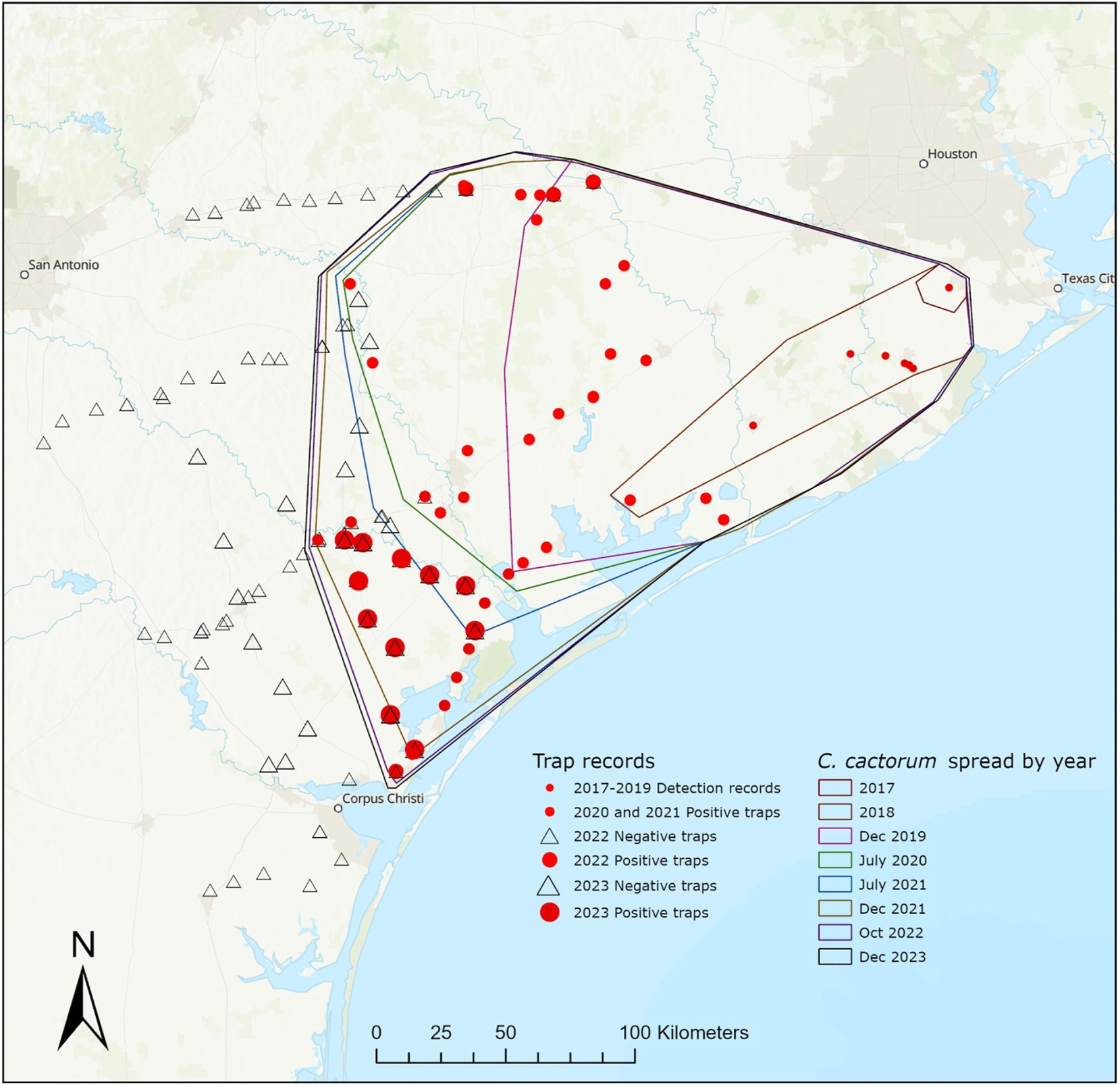
Over a four-year period, four overlapping flight paths of (C. cactorum) were observed during the peak Texas flight periods. Pheromone (sticky) traps were set within these flight paths across study areas located at the intersection of the Post Oak Savannah, Gulf Coast Prairies, and South Texas Plains ecoregions. Over 3,700 traps were deployed for 214 days, capturing 871 C. cactorum moths. These moths were identified using both morphological and molecular methods.
The data suggests that C. cactorum is more abundant in areas closer to the coast (78%) compared to inland areas (22%). Additionally, the moth density has expanded its range to the west and southwest, encroaching into previously unoccupied regions. This pattern may indicate competition between C. cactorum and native cactus moth species via shared parasitoids, a potential factor in the slowing of the moth's expansion. Cactoblastis cactorum has also demonstrated an ability to adapt to certain environmental factors such as temperature and wind patterns, highlighting its resilience as an invasive species.
About the invasive cactus moth: Native birds, reptiles, and other insects that rely on the cactus as a source of food and shelter are affected by the impact of the cactus moth invasion. The caterpillars bore into the cacti pads and consume it from the inside as the larvae mature. The caterpillars often leave the pads hollow/partially hollow, paper thin, and see-through- killing the pad. The larvae are pink and cream during the early instars (stages) and grow to become black with red dots on the dorsal (top) surface. If you believe you have identified a cactus moth infestation, please take a picture and REPORT IT! here. Submissions are appreciated, and we truly value your efforts and support.
Read the Research: Morrison et al., 2025
|
|
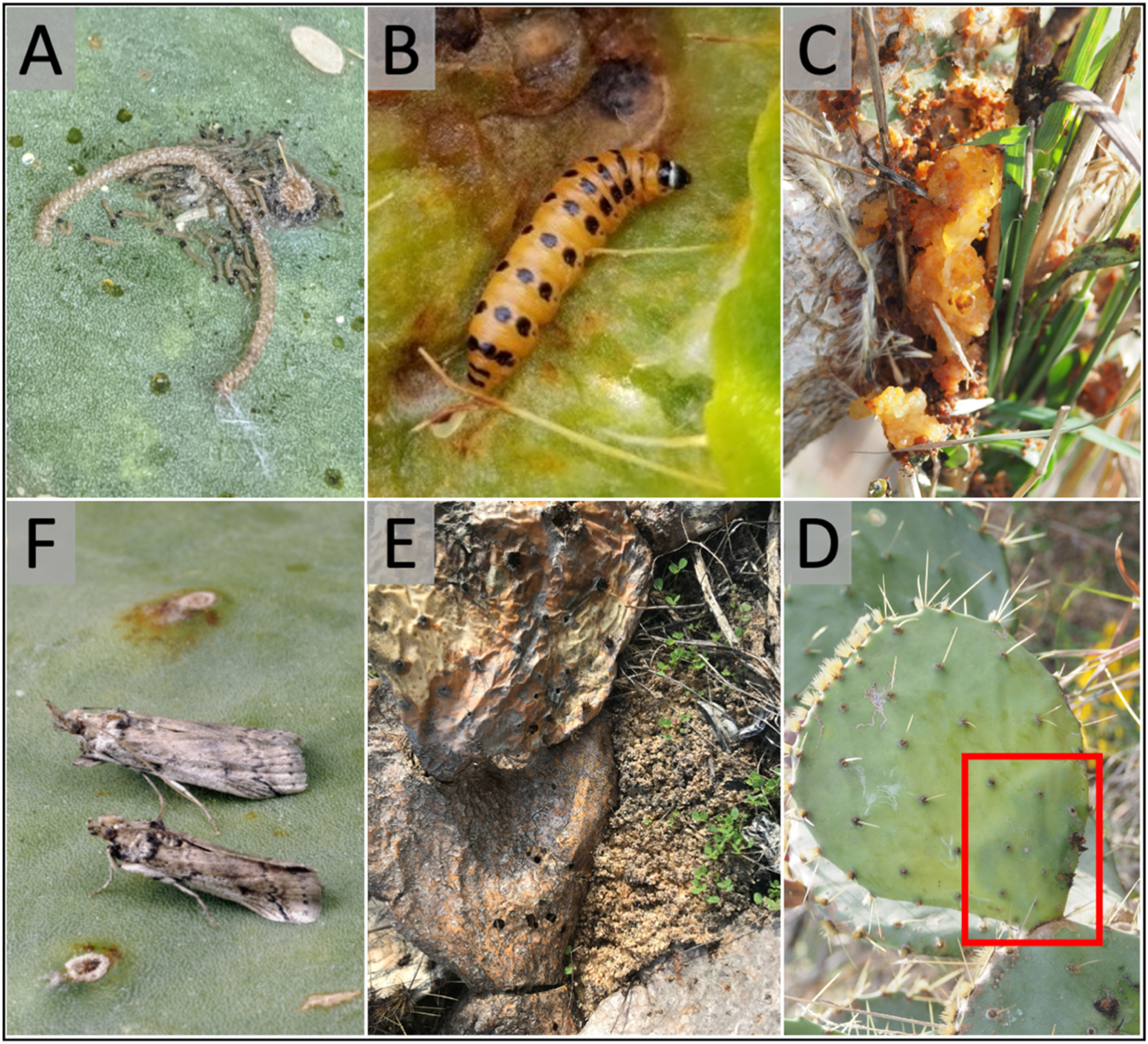 Cactoblastis cactorum egg stick and larvae (A), late instar larva (B), fresh larvae frass (C), cladode with tissue hollowed out by larvae (D), desiccated cladodes with heavy larval feeding damage and frass pile to the right (E), female (top) and male (bottom) moth (F). Credits: Invasive Species Research Lab at The University of Texas Austin (A–E), and Jeff Lotz at the Florida Department of Agriculture and Consumer Services (F) - Overall figure from Morrison et al., 2025 Cactoblastis cactorum egg stick and larvae (A), late instar larva (B), fresh larvae frass (C), cladode with tissue hollowed out by larvae (D), desiccated cladodes with heavy larval feeding damage and frass pile to the right (E), female (top) and male (bottom) moth (F). Credits: Invasive Species Research Lab at The University of Texas Austin (A–E), and Jeff Lotz at the Florida Department of Agriculture and Consumer Services (F) - Overall figure from Morrison et al., 2025
 Example of trap placed by TWPD research team during survey in Brownsville, TX, found to contain invasive redclaw crayfish. Credit: Morrison et al., 2025 Example of trap placed by TWPD research team during survey in Brownsville, TX, found to contain invasive redclaw crayfish. Credit: Morrison et al., 2025
|
|
|
|
|
|
Investigating the Hornet Gut
The Asian hornet, also known as the yellow-legged hornet (Vespa velutina), has become an invasive species, with its range now expanding to include much of Western Europe. While these hornets are primarily known for preying on honeybees, recent studies have revealed that their diet is much more varied. In areas where the Asian hornet has expanded, insect populations could be facing additional threats.
Asian hornet nests were sampled from four regions: Jersey, France, Spain, and the UK. The nests were categorized by size and then dissected. Larvae from unsealed cells were collected, and gut samples were extracted for further analysis. Deep sequencing was employed to analyze around 1,500 gut samples from over 100 nests, allowing researchers to identify the specific prey species consumed by the hornets. The prey found in the hornet’s diet included a wide range of bees, wasps, flies, beetles, butterflies, moths, and spiders. Of the top 50 invertebrate prey species identified, 43 are known to visit flowers, including Europe’s three main crop pollinators: the European honeybee (Apis mellifera), the buff-tailed bumblebee (Bombus terrestris), and the red-tailed bumblebee (B. lapidarius).
The hornets' diet also varied across seasons, activity periods, and regions. This demonstrates the high degree of flexibility exhibited by these hornets as invasive predators, underscoring their adaptability and success as an invasive species. The increased diversity in the hornet's diet not only demonstrates their adaptability but could also indicate broader ecological consequences, including potential disruptions to pollinator populations and ecosystem health.
Read the Research: Pedersen et al., 2025
Extra Note: The Asian hornet, a.k.a. yellow legged hornet (Vespa velutina) is a different, but related, species than the Asian giant hornet, a.k.a. northern giant hornet or murder hornet (Vespa mandarinia) that was previously found in Washington state and British Columbia Canada but has since successfully been eradicated from the U.S.
|
|
.%20Charles%20J.%20Sharp.jpg "Asian hornet (Vespa velutina). Charles J. Sharp") Asian hornet (Vespa veluina). Credit: Charles J. Sharp - Own work, Sharp Photography, sharpphotography. CC BY-SA 4.0 Asian hornet (Vespa veluina). Credit: Charles J. Sharp - Own work, Sharp Photography, sharpphotography. CC BY-SA 4.0
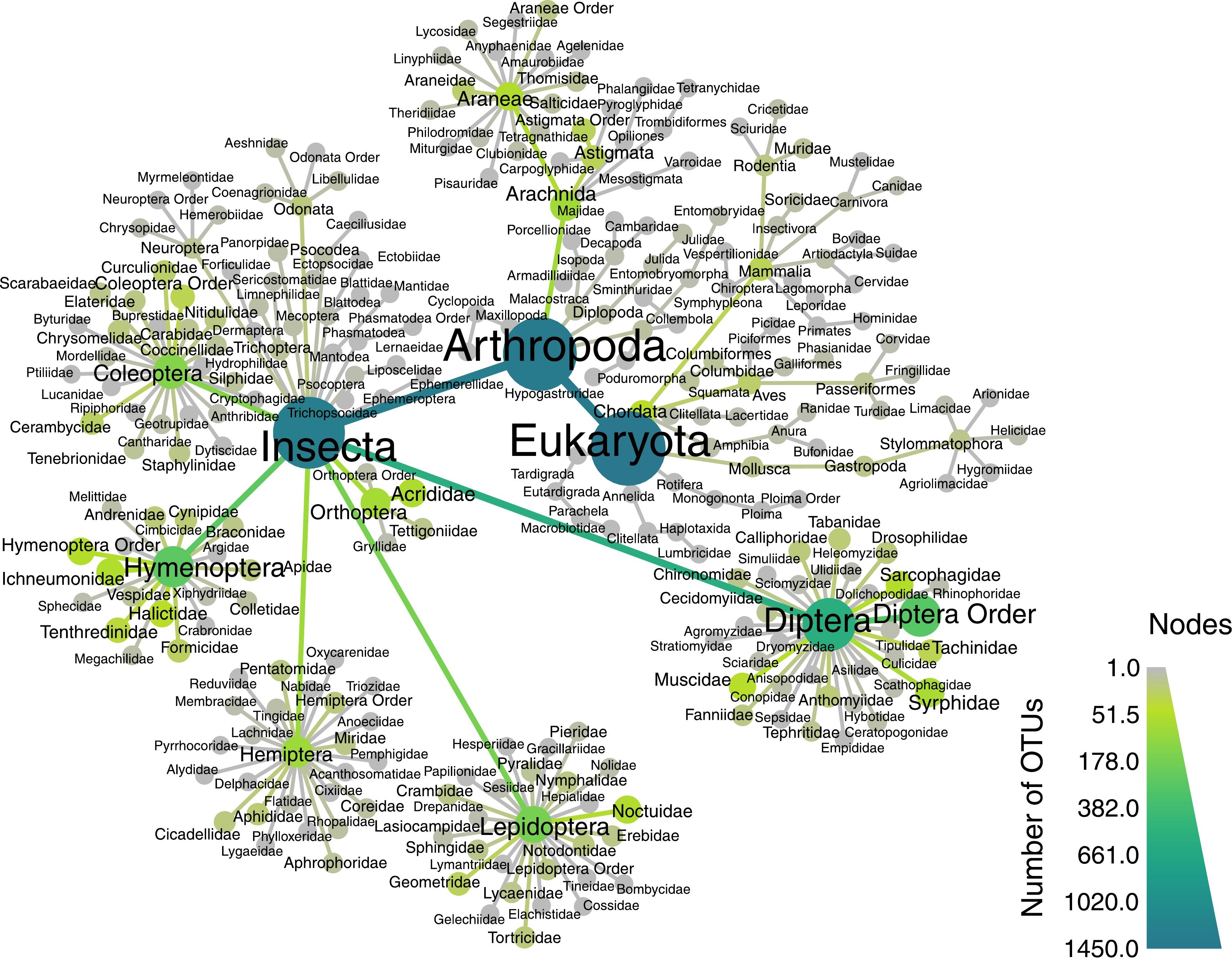 Overall diversity of taxa detected in the larval guts of V. velutina. The 1449 taxa across 26 orders are shown to family level for readability. Credit: Pedersen et al., 2025 Overall diversity of taxa detected in the larval guts of V. velutina. The 1449 taxa across 26 orders are shown to family level for readability. Credit: Pedersen et al., 2025
|
|
|
|
|
|
Grieving, Weaving, Healing
People participate in different death rituals to help heal and reflect on the loss of a loved one. In New South Wales, a coffin-weaving workshop is available, said to provide an intimate moment of connection with death and loss while creating sustainable coffins. The coffins are woven using materials like the invasive Cat's Claw vine (Dolichandra unguis-cati). These workshops have become a way for people to reconnect with death in a more meaningful way, allowing families to create unique coffins together.
The workshops offer a space for open, meditative conversations about death, where participants can actively engage in the process, often alongside the dying person, fostering a sense of closure and peace. Led by death educators, these workshops provide a unique approach to grief, blending creativity, reflection, and a deeper understanding of life and death. One woven coffin can take up to 150 hours to complete, and thus far, 15 coffins have been created through the workshops.
Flowers, feathers, shells, and personal items are often woven into each coffin to personalize it. Not only do these woven coffins provide a sustainable alternative to wood, but they also offer an opportunity for loved ones to come together during a difficult time. A family can spend weeks leading up to a loss weaving a coffin and preparing together.
Read the article to learn more.
|
|
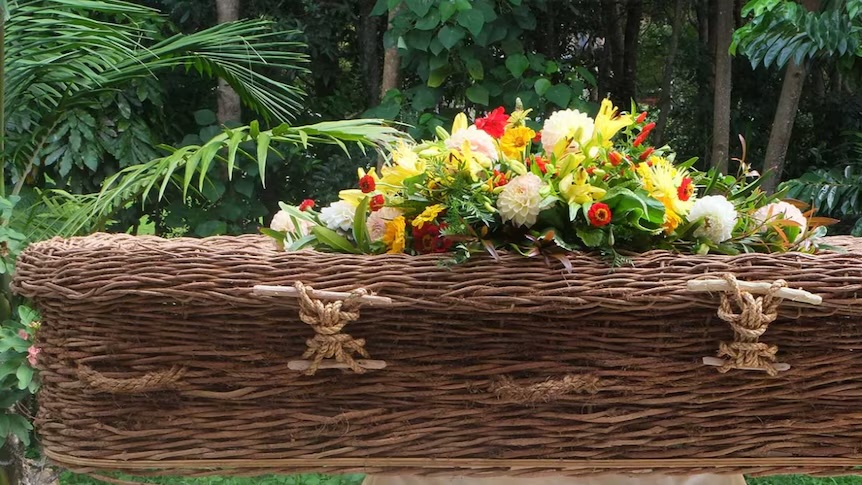 Personal items can be woven into the coffin during its construction. Credit: Zimmi Forest. Personal items can be woven into the coffin during its construction. Credit: Zimmi Forest.
|
|
|
|
|
|
Don’t Mess With Texas Citrus
TISI is offering FREE diagnostic services if you suspect your citrus has either the psyllid pest or the Citrus Greening pathogen, or you would like your citrus plants to be part of our screening survey.
The Asian citrus psyllid (Diaphorina citri) and the Citrus Greening pathogen (Candidatus Liberibacter asiaticus) are threatening citrus in multiple Texas counties. By taking samples and monitoring the spread, it is easier to ensure that you and your neighbors are not affected. This pest and pathogen are extremely detrimental to Texas citrus, both economically and agriculturally. The presence of either can greatly affect citrus yield.
If you are interested in having your citrus trees checked or being part of the survey, please contact invasives@shsu.edu. If you are located within 200 miles of our headquarters, we can collect samples and/or provide traps and monitoring services. Otherwise, we will send you easy step-by-step instructions so you can do it yourself. Not only will we share the results and management strategies (where applicable), but you will become part of a multi-county monitoring survey that strives to improve the health of Texas citrus!
Also Available: TISI offers educational workshops that highlight information about the Asian citrus psyllid, the pathogen Citrus Greening, and what you need to look out for in your own backyard. If you are interested in this, TISI will provide trapping materials, assist with management strategies, and more. Don’t waste another second- Help us stop the spread!
|
|
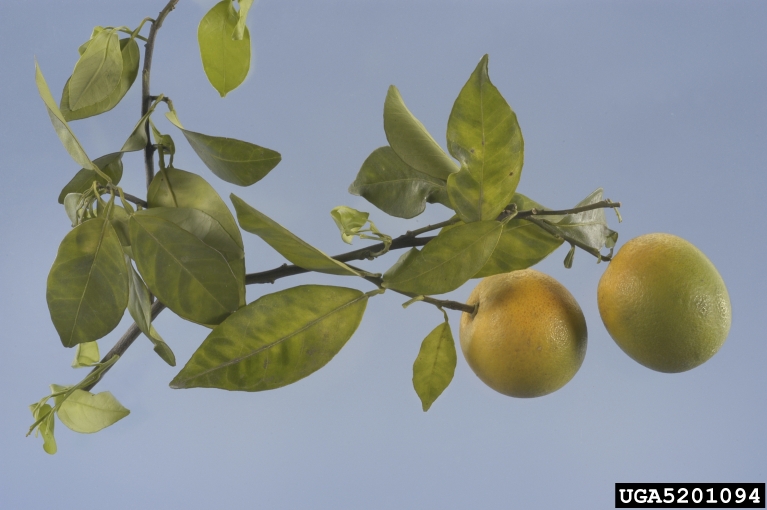
Symptoms of citrus greening bacterium. Credit: Jeffrey W. Lotz, Florida Department of Agriculture and Consumer Services, bugwood.org
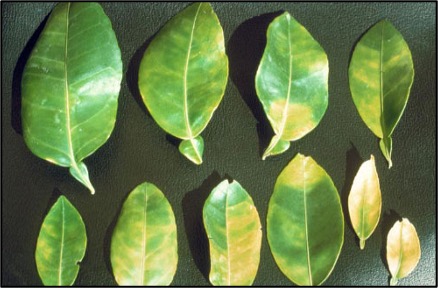
Leaf mottle on grapefruit, a characteristic symptom caused by citrus greening bacterium but also seen on trees infected by Spiroplasma citri. Credit: J.M. Bove.
|
|
|
|
|
|
North American Invasive Species Management Association Training Webinars
This program is designed to provide the education needed for professionals and students who are managing or learning to manage invasive species. The courses include the most current invasive species identification, control, and management techniques, and how to comply with local and federal regulations.
Participants may register and enroll at any time, and will receive a certificate of invasive species management from NAISMA upon completion of the program.
All live webinars are open to the public. Recorded webinars are available to members of NAISMA.
NAISMA 2025 Webinar Schedule:
- April 16, 1pm CST- Spotted Lanternfly in North America: Insights, Impacts, and Preparing for the Future. REGISTER.
- May 21, 1pm CST- Beyond Buckthorn: Innovative Strategies for Invasive Control and Habitat Restoration. REGISTER.
|
|

|
|
|
|
|
|
Awareness Week Continues
A small coastal town has turned National Invasive Species Awareness "Week" into a month-long event by sharing information about the most aggressive plants that have become established on the island. The city of Sanibel’s Natural Resources Department has shared the information from the Sanibel Vegetation Committee.
The following are the eight most aggressive invasive plants that have become established on the island: Brazilian peppertree (Schinus terebinthifolia), air potato (Dioscorea bulbifera), earleaf acacia (Acacia auriculiformis ), exotic inkberry (Scaevola sericea), java plum (Syzygium cumini), lead tree (Leucaena leucocephala), mother-in-law’s tongue (a.k.a. snake plant, Sansevieria hyacinthoides), and Melaleuca (Melaleuca quinquenervia). These are considered the "worst of the worst in Sanibel."
As part of the continuation of National Invasive Species Awareness Week, thus far the following information pages have been posted:
Brazilian pepper tree
Mother-in-law’s tongue
Air potato
|
|
 Credit: City of Sanibel Natural Resources Department Credit: City of Sanibel Natural Resources Department
|
|
|
|
|
|
NAISMA Weed Biocontrol Fact Sheets
The Classical Biocontrol Committee provides a small library of weed biocontrol publications. Each publication is peer-reviewed and designed to help landowners and weed managers identify and understand weed species, as well as learn about their biocontrol agents in North America. The weed fact sheets cover plant identification, history, distribution, ecology, habitat, and comparisons to look-alike species. The biocontrol agent fact sheets provide information on agent identification, life cycle, impact, habitat requirements, history, and status for biocontrol agents or accidentally introduced species associated with their host plant species.
Click HERE to explore the free publications.
|
|
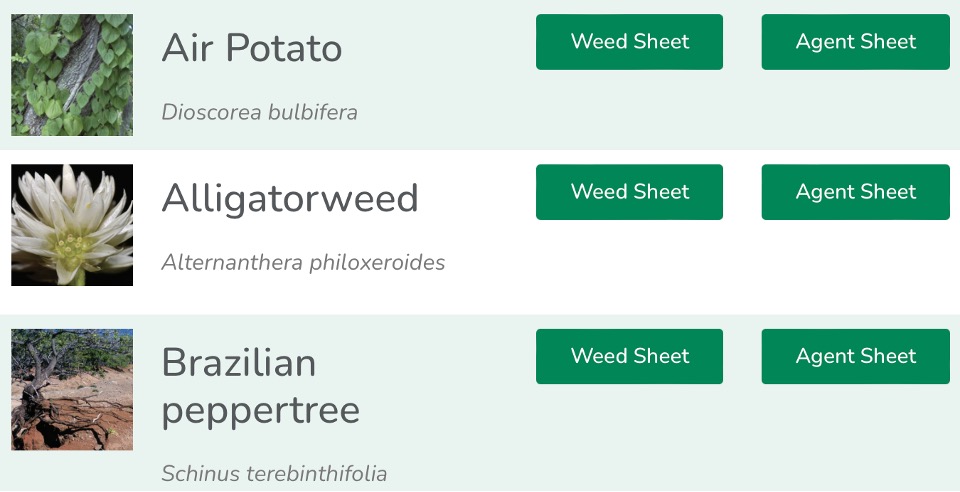 Credit: NAISMA Credit: NAISMA
|
|
|
|
|
|
Invasive Spotlight:
Florida Bark Scorpion
(Centruroides gracilis)
The Florida bark scorpion (Centruroides gracilis) is typically reddish brown, but can range from black, red, or brown, with or without bands or markings of red, yellow, brown, black, or orange. Adult males are large compared to the females, measuring 50-153 mm vs. 60-100 mm in length, respectfully.
The female gestation period varies from several months to over a year, at which point they can give birth to 25-35 young. After birth, the young climb and attach to the mothers back where they remain until the first molt (about one week). After the first molt, they become independent of the mother, and molt 5-7 additional times before reaching maturity. Adults can differ in color from offspring. Newborn (nymphs) are small and pale at birth but begin taking on adult characteristics after the first molt. Males and females mature at different rates. Female nymphs reach maturity after the 7th instar, while males mature at the onset of the 6th instar.
Centruroides gracilis is venomous but is not considered dangerous or deadly. The venom can cause pain, redness, itching, and/or swelling. As a result, minimal research has been conducted on this species. However, it is still considered a threat to safety because it is venomous and will take up residence in homes. In the United States (where introduced), they can be found hiding under stones, or wood piles, and inside or outside buildings.
The Florida bark scorpion has been reported in many southern states, including Texas. For more information, view the TexasInvasives info page HERE. If you believe you have identified a Florida bark scorpion, please take a picture and REPORT IT! to invasive@shsu.edu. Submissions are appreciated, and we truly value your efforts and support.
|
|
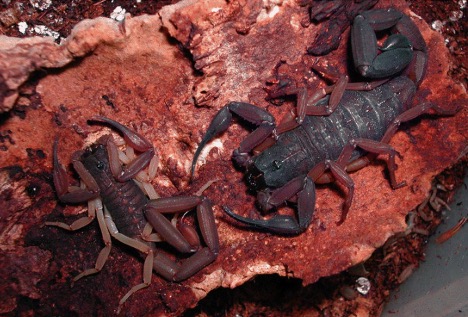
Male and female Florida bark scorpion ( Centruroides gracilis) from Colombia. Credit: Eric Ythier, Latreille (1804).
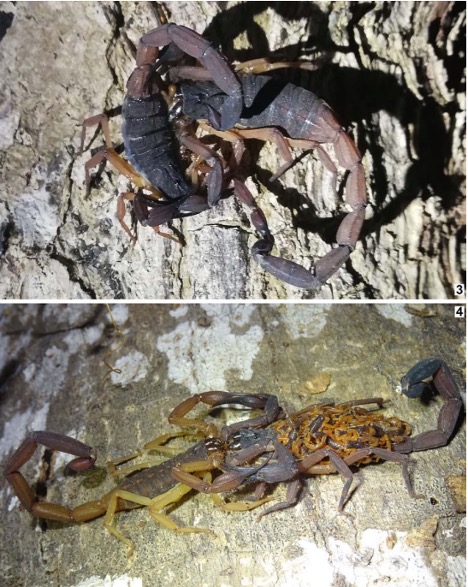
Top) Example of cannibalism observed between adult female C. gracilis of similar size. Bottom) An adult male C. gracilis (left) tentatively courting an adult female (right), while the female carries her prior brood on her back. Credit: Top) Anna Davison, Bottom) Tom W. Brown, Davidson, Brown, and Arrivillaga (2020).
|
|
|
|
|
|
Video Invasion
Enjoy monthly videos about invasive species and/or people willing to teach us more about them. There are some amazing citizens and professionals around the world that poke, prod, chase, dive, and investigate everything they can about these alien invaders. Jump into this cinematic rabbit hole. You never know what new wonders you may discover.
Monmouth University Student Identifies New Invasive Species. PBS.Org
A college assignment led to a student’s discovery of a non-native species in New Jersey. Since the initial observation, the beadlet anemone (Actinia equina) appears to be competing with native species found on the shared rock spaces. The student and teacher team are worried what impact the anemone will have on the local ecosystem.
Grasshoppers Versus Water Hyacinths In South Africa. Global Ideas. DW News
Water hyacinth (Eichhornia crassipes) is a globally problematic invasive plant outside its native range of Central and South America. It can quickly grow dense, thick mats that overtake an entire body of water and devastate whole ecosystems. There may be new hope with the help of a new potential biocontrol, the water hyacinth planthopper (Megamelus scutellaris).
Note: The biocontrol mentioned/seen in the video are not “locusts” or grasshoppers (Orthoptera) as stated by the narrator, they are planthoppers (Hemiptera).
Case #2 Ballast Water. Science Education. Invasive Species. Sooper Yooper TV
Ballast water is necessary for keeping freighters and cargo ships balanced for smooth movement during sailing. Unfortunately, ballast water is also responsible for the introduction of more than 7,000 invasive and non-native species worldwide. Sooper Yooper case #2 explains how this happens. Each ‘case’ is based on a popular school program about invasive species in the U.S. and the Great Lakes.
|
|
|
|
|
|
More News
Opinion: Our Toxic Relationship with Herbicides
An interesting first-hand account of a love-hate relationship with herbicides. Even scientists can feel conflicted when trying to figure out the best methods when facing herbicides vs risk vs management. unbark.org
New Research Uncovers Surprising Side Effect of Eradicating Invasive Species: ‘[An] Effective Nature-Based Solution’
Invasive species removal combats biodiversity loss but can also impact climate resilience by helping to combat rising global temperature. msn.com
Researchers Uncover Traits That Help Plants Succeed in New Environments While Guarding Against Invasiveness
A study aims to determine which traits could lead to success, which to ecological disaster, and which help plants establish themselves in new locations, whether they are invasive species or relocation candidates. phys.com
Natural Insect Predators May Serve as Allies in Spotted Lanternfly Battle
Insect predators found in the United States could help keep spotted lanternfly (Lycorma delicatula) populations in check while potentially reducing reliance on chemical control methods. psu.edu
DNA Barcodes Narrow Down Possible Sources of Introductions of an Invasive Banana Skipper Butterfly Pest
New research suggests that gravid female moths may be attracted to airport lights while aircraft are being loaded at night and settling within aircraft before departure suggesting that aircrafts are a pathway into new areas. cabidigitallibrary.org
Scientists Hope Hungry Weevils from Louisiana Can Tackle South Africa's Invasive Water Plants
Salvinia weevils (Cyrtobagous salviniae) have been used to control the spread of salvinia (Salvinia minima) in parts of the United States. Now, these weevils could help reduce the aquatic mats that have taken over South Africa's Crocodile River. phys.org
The Invasive Longhorned Tick Has Made Its Way to St. Louis. Here's What to Know
The invasive longhorned tick (Haemaphysalis longicornis) has been discovered in St Louis County and with a new grant, researchers aim to investigate the potential of additional dispersal. stlpr.org
Social Media Can Help Track Species as Climate Changes
Social media can be used to complement, not replace, traditional monitoring can help scientists track animal species as they relocate in response to climate change. news.exeter.ac.uk
PA Invasive Replace-ive Program
A new multi-agency program providing education and native trees as replacements for removed invasive trees and shrubs. extention.psu.edu
Revamped Invasive Species Bills Head to Governor for Second Time
A bill passed in Virginia that requires stores to post signage to educate consumers on invasive plants and promote native plant alternatives. virginiamercury.com
|
|
|
|
|
|
Sentinel Pest Network and Invaders of Texas Workshops
Invaders of Texas workshops train volunteers to detect and report invasive species as citizen scientists. Workshops, which are free, are designed to introduce participants to invasive species and the problems they cause, cover aspects of invasive species management, teach identification of local invasive plants, and train participants to report invasive plants using the TX Invaders mobile application. The workshop is 7 hours long (usually on a Saturday, but scheduling is arranged with each individual host group). The workshop satisfies Master Naturalist training requirements.
Sentinel Pest Network workshops serve to increase the awareness and early detection of a set of particularly important invasive species to help prevent their spread into Texas or their further spread within Texas. Participants learn to identify species such as the Emerald Ash Borer, Cactus Moth, Asian Longhorned Beetle, and other pests of regulatory significance, and to report them. The workshop is 3.5 hours long. The workshop satisfies Master Naturalist training requirements.
Upcoming Workshops:
N/A
CITRUS WORKSHOPS: Stay tuned for upcoming 2023 virtual weekend presentations about Citrus diseases and FREE testing we offer at Texas Invasive Species Institute.
|
|
|
|