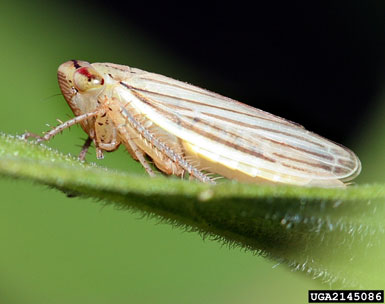
David Cappaert,
Michigan State University
Class: Insecta
Order: Hemiptera
Family: Cicadellidae
Synonym(s):
Adult Description: The adult Silver Leafhopper (Athysanus argentarius) is 7-8 mm in length with an ivory colored body. The body has straw colored lateral stripes on the dorsal side of the wings. There is also brown coloring on the legs and between the eyes.
Larva Description: Athysanus argentarius larvae are lightly colored and similar to the adult form with small brown markings on the legs.
Host Plant: Tall grasses including lawns and hayfields
History: Athysanus argentarius is native to the coastal regions of Europe. In the 20th century it migrated to North America and began expanding and establishing populations as far north as Montana and Michigan as well as coastal states such as Virginia.
Biology: The silver leafhopper is capable of migration to different areas due to its small size and flying ability. The leafhoppe takes fluids from the phloem of the host plant and can transmit the yellow aster disease which causes mass destruction to a field, even killing nearby trees.
Ecological Threat: Athysanus argentarius are a threat to tall grasses and are known to carry yellow aster disease, which currently has no cure.
US Habitat: Tall grasses and fields
Distribution
Native Origin: Europe
US States: Athysanus argentarius is currently found in coastal areas of the United States.
Texas:
Resembles: The Silver Leafhopper is similar to other leafhoppers in terms of shape such as the Red-streaked Leafhopper (Balclutha rubrostriata), but differs in total body color and lacks red stripes found on the red-streaked leafhopper.
Management: Little information is available at this time regarding the Silver Leafhopper. Specific pesticides at this time are not known, but general insect pesticides that work on other leafhopper species are believed to be effective with the Silver Leafhopper as well.
Text References
Bess, James, Kevin O'Neill, and William Kemp. 2004. Leafhopper Assemblages On Native and Reseeded Grasslands in Southwestern Montana. Western North American Naturalist 64(4): 518-531.
Summers, C. G., J. J. Stapleton. 2002. Management of corn leafhopper (Homoptera: Cicadellidae) and corn stunt disease in sweet corn using reflective mulch. Journal of Economic Entomology 95(2): 325-330.
Data Source
http://bugguide.net
http://www.insectsofwestvirginia.net
Last Updated: 2011-08-26 by Amber Bartelt - Sam Houston State University