Victor Madamba,
Houston-Galveston Invaders
Family: Lemnaceae (Duckweed Family)
Synonym(s): Spirodela oligorrhiza, Spirodela punctata
Duration: Perennial
Habit: Herb
Listed by:
Invasive Plant Atlas of the US: 1
Federal Noxious Weed: 0
TDA Noxious Weed: 1
TPWD Prohibited Exotic Species: 1
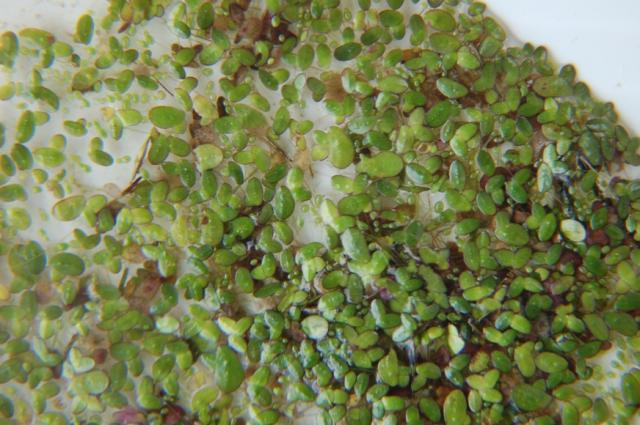
Description: Tiny free-floating aquatic plants comprised of individual fronds that produce fine roots. Mature fronds appear 1.5 to 2 times longer than wide, with widths measuring from 1-3 (or 5) mm. Fronds are narrowly egg-shaped to slightly kidney-shaped and intensely green in color. A waxy layer of cuticle makes plants sparkle in the sunlight. Fronds are not leaves; they may be a reduced form of stem and shoot. The roots number from 2-4 and can range up to 7. All of the roots penetrate the prophyllum (a scale surrounding the base of the frond that covers the point of attachment of the roots)
History:
Agriculture: Introducted to nutrient filled waste water ponds as a means to absorb excess nutrients. Also, could potentially be utilized as a fertilizer.
Pet/aquarium trade: L. punctata was introducted via the aquarium trade to the USA.
Biology & Spread: Propagation is mainly through vegetative budding of daughter fronds from two pouches at base of the frond. Daughter fronds often remain attached to mother frond by a short stipe so that plants often appear as a cluster of several fronds. This species occasionally reproduces sexually, by seed.
Ecological Threat: Unknown, but that it has the potential to become a serious nuisance due to its rapid colonization, easy distribution, and quick dispersal rate.
US Habitat: small, quiet, nutrient rich waters such as ponds, ditches, swamps and backwaters; also seasonally intermittent waters.
Distribution
US Nativity: Native to U.S.
Native Origin: Australia and Southeast Asia.
US States: AL, AR, AZ, CA, DC, DE, FL, GA, IL, KY, LA, MO, MS, NC, OR, PA, SC, TX, VA
Resembles/Alternatives: Spirodela polyrhiza (giant duckweed)
Management:
Chemical: Diquat is a widely used and effective herbicide because it causes ion leakage in duckweed and other aquatic plants. A Florida study showed that after 20-30 years, Landoltia punctata developed resistance to Diquat and Paraquat herbicides. The mechanism of resistance to Diquat is independent of electron transport in photosynthesis, and therefore is not exclusive to photosynthesis. A separate study indicated that Landoltia punctata was not adequately controlled by Carfentrazone-ethyl at the maximum proposed rate of 224g/ha Super(-1).
USE PESTICIDES WISELY: ALWAYS READ THE ENTIRE PESTICIDE LABEL CAREFULLY, FOLLOW ALL MIXING AND APPLICATION INSTRUCTIONS AND WEAR ALL RECOMMENDED PERSONAL PROTECTIVE GEAR AND CLOTHING. CONTACT YOUR STATE DEPARTMENT OF AGRICULTURE FOR ANY ADDITIONAL PESTICIDE USE REQUIREMENTS, RESTRICTIONS OR RECOMMENDATIONS. MENTION OF PESTICIDE PRODUCTS ON THIS WEB SITE DOES NOT CONSTITUTE ENDORSEMENT OF ANY MATERIAL.
Listing Source
Texas Department ofAgriculture Noxious Plant List
Texas Parks and Wildlife Department Prohibited Exotic Species
Invaders Program
Federal Noxious Weed
Union of Concerned Scientists
United States Forest Service Southern Research Station
Text References
CAIP-WEBSITE, 2006. University of Florida. Center for Aquatic and Invasive Plants. APIRS. Landoltia punctata (Spirodela punctata) [Online Database]
Chaiprapat, S., Cheng, J.J., Classen, J.J., & S.K. Liehr. 2005. Role of Internal Nutrient Storage in Duckweed Growth for Swine Wastewater Treatment. Transactions of the ASAE. Vol. 48(6): 2247-2258
Koschnick, T.J., W.T. Haller & A.W. Chen. Carfentrazone-ethyl Pond Dissipation and Efficacy on Floating Plants. Journal of Aquatic Plant Management 42: 103.
Koschnick, T.J., Haller, W.T. & L. Glasgow. 2006. Documentation of Landoltia (Landoltia punctata) resistance to Diquat. Weed Science. Vol. 54, No. 4, pp. 615-619.
Data Source
USGS. Nonindigenous Aquatic Species
Last Updated: 2021-06-11 by HTG