Vic Ramry,
University of Florida
Family: Plantaginaceae
Synonym(s):
Ambulia sessiliflora, Hottonia sessiliflora,
Stemodia sessiliflora, Stemodiacra sessiliflora, Terebinthina sessiliflora
Duration: Perennial
Habit: Mostly submersed aquatic forb/herb
Listed by:
Invasive Plant Atlas of the US: 1
Federal Noxious Weed: 1
TDA Noxious Weed: 0
TPWD Prohibited Exotic Species: 1
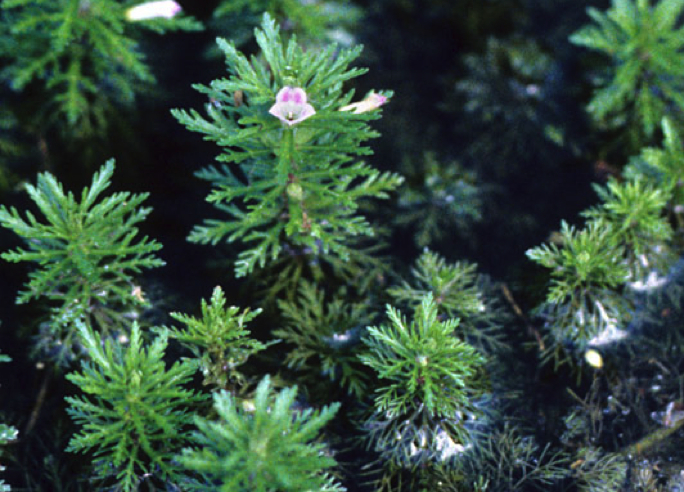
Description: Limnophila has distinctly different submersed and emergent forms of leaves. This species is an obligate wetland species, meaning it requires a wet, aquatic habitat. The plant is rooted in the substrates of water bodies or wet soil and may produce roots at each stem node. Stems may reach up to 12 feet (3.7 m) in length, growing from the bottom to the surface, with several inches erectly emergent (i.e., extending above the surface of the water). Leaves are present in whorls along both submersed and emergent portions of the stem, and may be up to 2 inches (5 cm) in length. Emergent leaves are dark green, lanceolate in shape and arranged in whorls of 5-8 leaves around the stem. Margin of emergent leaves appears to be torn irregularly, appearing serrate to variously lacerate. In contrast, submersed leaves are finely divided and feather-like. The submersed leaves are arranged in whorls of 6-10 (or more) around the stem and can vary in shape from ovate to elliptic or broadly lanceolate. In Texas, flowering is known to occur from July through November (Correll & Correll 1975). Flowers are small, sessile (without stalks), and solitary and located on the uppermost part of the stems above the water in the leaf axils (angle where leaf meets stem). Flower petals can be blue-violet, pink or lavender in color and the upper lip of the flower has two dots, and is lobed and ovate in shape .
History: Limnophila is frequently cultured as an aquarium plant and is widely available from online sellers, despite being listed as a federal noxious weed. The species was first brought to the United States as an aquarium plant. This species has been spread within the US via fragments transported on boats, pumps, and other equipment moved between water bodies.
Biology & Spread: Limnophila reproduces both asexually, regrowing and spreading from plant fragments, and sexually, producing seeds. Each flower may produce as many as 200-300 seeds, which have a germination rate as high as 96% (Spencer and Bowes 1985).
Ecological Threat: Limnophila grows rapidly and may form dense stands, reaching from the bottom to the top of the water column in depths up to 12 feet (3.7 m) and shading out and out competing other submersed species as well as impacting water quality. Large patches may clog irrigation ditches and flood canals, as well as pumping and power stations. This species spreads rapidly via fragmentation and management is difficult.
US Habitat: Limnophila is known to grow in a wide variety of aquatic habitats, including lakes, rivers, springs, streams, and damp soils.
Distribution
US Nativity: Introduced to U.S.
Native Origin: India, Sri Lanka, and the Philippines.
US States: FL, GA, TX
Resembles/Alternatives: Limnophila could potentially be confused with parrotfeather milfoil (Myriophyllum aquaticum), an invasive species found in Texas that has a similar growth habit; however, the emergent leaves of parrotfeather are glaucous (bluish-green, waxy/powdery) and very deeply dissected into segments. Limnophila somewhat resembles native native fanwort (Cabomba caroliniana), which also has finely divided submersed leaves; however, submersed leaves of fanwort are alternate rather than arranged in whorls, and only the flowers of fanwort are emergent. It could also be confused with native coontail (Ceratophyllum demersum); however, coontail leaves have bumps on the midribs, which gives them a rough texture when passing your hand over them. Coontail also has only very small flowers which are rarely seen.
Management: Prevention is the best management practice—clean, drain and dry boats, trailers, and equipment to prevent spreading this species. Mechanical removal is ineffective and may serve to spread fragments which quickly regrow. Grass carp, often used as a biological control for aquatic plants, do not readily consume L. sessiliflora. Aquatic herbicides have provided little control of this species, although high levels of 2-4,D have been reported to kill this plant (Mahler 1980) and amide and phenoxy herbicides have been found to be effective (Wang et al., 2000). In the late 1990s, failure to control this species in Japan revealed a resistance to Sulfonyurea (SU) family herbicides (Wang, et al. 2000).
USE PESTICIDES WISELY: ALWAYS READ THE ENTIRE PESTICIDE LABEL CAREFULLY, FOLLOW ALL MIXING AND APPLICATION INSTRUCTIONS AND WEAR ALL RECOMMENDED PERSONAL PROTECTIVE GEAR AND CLOTHING. CONTACT YOUR STATE DEPARTMENT OF AGRICULTURE FOR ANY ADDITIONAL PESTICIDE USE REQUIREMENTS, RESTRICTIONS OR RECOMMENDATIONS. MENTION OF PESTICIDE PRODUCTS ON THIS WEB SITE DOES NOT CONSTITUTE ENDORSEMENT OF ANY MATERIAL.
Listing Source
Texas Department ofAgriculture Noxious Plant List
Texas Parks and Wildlife Department Prohibited Exotic Species
Invaders Program
Federal Noxious Weed
Union of Concerned Scientists
United States Forest Service Southern Research Station
Text References
Identification and Biology of Nonnative Plants in Florida’s Natural Areas – Second Edition, by K.A. Langeland, H.M. Cherry, et al. University of Florida-IFAS Pub SP 257. 2008.
Mahler MJ. 1980. Limnophila, a new exotic pest. Aquatics 2:4-7
Spencer W, Bowes G. 1985. Limnophila and Hygrophila: a review and physiological assessment of their weed potential in Florida. J. Aq. Pl. Manag. 23:7-16
Correll D, Correll H. 1972. Aquatic and Wetland Plants of the Southwestern United States. Environmental Protection Agency. Washington, D.C. 1777 pp.
Guang-Xi Wang, Hiroaki Watanabe, Akira Uchino, Kazuyuki Itoh, Response of a Sulfonylurea (SU)-Resistant Biotype of Limnophila sessiliflora to Selected SU and Alternative Herbicides, Pesticide Biochemistry and Physiology, Volume 68, Issue 2, October 2000, Pages 59-66, ISSN 0048-3575, http://dx.doi.org/10.1006/pest.2000.2504. (http://www.sciencedirect.com/science/article/pii/S0048357500925045)
Data Source
Limnophila sessiliflora. Center for Aquatic and Invasive Plants, University of Florida, IFAS. http://plants.ifas.ufl.edu/node/234#1
Limnophila – Limnophila sessiliflora (Vahl) Blume. Invasive Plant Atlas of the United States. http://www.invasiveplantatlas.org/subject.html?sub=4651
Limnophila sessiliflora (Vahl) Blume – Asian Marshweed. USDA Natural Resources Conservation Service Plants Database. http://plants.usda.gov/core/profile?symbol=Lise3
Limnophila – Limnophila sessiliflora (Vahl) Blume. Invasive.Org, Center for Invasive Species and Ecosystem Health. http://www.invasive.org/browse/subinfo.cfm?sub=4651
Ecology of Limnophila sessiliflora. Global Invasive Species Database. http://www.issg.org/database/species/ecology.asp?si=602
Last Updated: 2015-03-14 by JDB