Sign up for the iWire to get breaking news, event info and the species spotlight.
Go Back | Printer Friendly Fact Sheet
 Federal Noxious Weed TDA Noxious Weed TPWD Prohibited Exotic Species
  Invasive Plant Atlas of the US
NOTE:
means species is on that list.
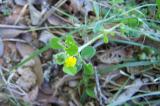
Trifolium campestre
Field clover
Synonym(s):
Family: Fabaceae (Pea Family)
Duration and Habit: Annual, Biennial Herb

Photographer: John D. Byrd
Source: Mississippi State University, Bugwood.org
Description
Prostrate or ascending annual sparsely hairy or glabrescent; branches to 50 cm long. Leaves 3-foliolate; leaflets rhombic or obovate, 8-16 mm long, 4-8 mm wide, 1- times as long as broad, finely toothed. Inflorescences 8-15 mm long, 7-10 mm diam., axillary; peduncle shorter or longer than subtending leaf. Flowers on pedicels c. 0.5 mm long, deflexed after anthesis. Calyx tube 5-veined, unchanged in pod; throat glabrous, open; teeth unequal, spiny, erect to spreading in pod. Corolla 4-7 mm long, longer than calyx, yellow, persistent. Pod oblong, 1-2 mm long, 1-seeded, included in calyx.
Native Lookalikes: Currently no information available here yet, or there are no native Texas species that could be confused with Field clover.
Ecological Threat:
Biology & Spread:
History: Trifolium campestre thrives in temperate regions and does not do as well in dry or hot humid climates. T. campestre is good for pastures because of their nutritional quality and nitrogen fixing abilty. Although this plant is a weedy plant, it is still valuable as a soil builder. T. campestre displays rapid spring growth. Low Hop clover is also known as a food source for some animals and insects although this clover is not eaten as much as it's relative clovers. The plant is usually locally plentiful in the Eastern U.S., but it's value to wildlife is slight.
U.S. Habitat: Meadows, along borders of fields, lawns, roadsides, waste places, and especially in resting pastures
Distribution
U.S. Nativity: Introduced to U.S.
Native Origin: Mediterranean region (NatureServe Explorer)
U.S. Present: AK, AL, AR, CA, CT, DE, FL, GA, IA, ID, IL, IN, KS, KY, LA, MA, MD, ME, MI, MN, MO, MS, MT, NC, ND, NE, NH, NJ, NM, NY, OH, OK, OR, PA, RI, SC, TN, TX, VA, VT, WA, WI, WV
Distribution in Texas: From Florida to Eastern Texas
Mapping
Invaders of Texas Map: Trifolium campestre
EDDMapS: Trifolium campestre
USDA Plants Texas County Map: Trifolium campestre
Invaders of Texas Observations
List All Observations of Trifolium campestre reported by Citizen Scientists


Native Alternatives
Management
USE PESTICIDES WISELY: ALWAYS READ THE ENTIRE PESTICIDE LABEL CAREFULLY, FOLLOW ALL MIXING AND APPLICATION INSTRUCTIONS AND WEAR ALL RECOMMENDED PERSONAL PROTECTIVE GEAR AND CLOTHING. CONTACT YOUR STATE DEPARTMENT OF AGRICULTURE FOR ANY ADDITIONAL PESTICIDE USE REQUIREMENTS, RESTRICTIONS OR RECOMMENDATIONS. MENTION OF PESTICIDE PRODUCTS ON THIS WEB SITE DOES NOT CONSTITUTE ENDORSEMENT OF ANY MATERIAL.Text References
Edsall, Marian S. 1985. Roadside Plants and Flowers.The University of Wisconsin Press, Madison WI.
Foote, Leonard E. & Wilbur H. Duncan. 1975.Wildflowers of the Southeastern United States. University of Georgia Press. Athens, GA.
PlantNet. 2009. New South Wales Flora Online: Trifolium campestre Schreb.Accessed February 2009: http://plantnet.rbgsyd.nsw.gov.au/cgi-bin/NSWfl.pl?page=nswfl&lvl=sp&name=Trifolium~campestre
Zohary, M. & D. Heller. 1984. The Genus Trifolium. The Isreal Academy of Sciences and Humanities, Ahua Printing Press. Jerusalem.
Online Resources
Search Online
Google Search: Trifolium campestre
Google Images: Trifolium campestre
NatureServe Explorer: Trifolium campestre
USDA Plants: Trifolium campestre
Invasive Plant Atlas of the United States: Trifolium campestre
Bugwood Network Images: Trifolium campestre


